Tag: Primary

  • The Heart’s Alarm: The True Meaning of Fear 🧠💡 (Cuento AICLE / Emocrea – 3.º Ciclo Primaria)

    The Heart’s Alarm: The True Meaning of Fear 🧠💡 (Cuento AICLE / Emocrea – 3.º Ciclo Primaria)

    ¡Bienvenidos a una nueva entrada en nuestras secciones de Year 6A y Resources & Materials! Hoy compartimos el vídeo y la historia adaptada para el Tercer Ciclo de Primaria (5.º y 6.º cursos).

    En esta historia, acompañaremos a Mateo y a Nora en una reflexión muy interesante: ¿cómo transforma la publicidad de Halloween el miedo en un simple espectáculo de consumo? Juntos descubrirán que el miedo auténtico no es un enemigo que nos paraliza ni un monstruo para vender disfraces, sino un “sistema de alarma biológico” sabio que nos protege frente a peligros reales y nos impulsa a cuidar de nuestros seres queridos.

    📚 ¿Qué áreas trabajamos con este cuento?

    • Emocrea: Análisis crítico de nuestro entorno, comprensión y regulación emocional, empatía profunda y emprendeduría social a través de la creatividad.
    • Inglés (AICLE / CLIL): Vocabulario avanzado, estructuras narrativas más complejas y comprensión oral (listening) contextualizada en la educación emocional.

    📖 The Full Story

    The Heart’s Alarm: The True Meaning of Fear

    By David Toledo.

    Late in October, Mateo walked through the noisy shopping centre. Everything around him felt like a fake storm of panic: huge horror movie posters, flashing red lights, mechanical skeletons, and adverts shouting at people to buy scary costumes and spooky decorations. Mateo had a tight feeling in his stomach. It felt as if the world was a dangerous place, and the only way to feel safe was to keep buying things.

    The next morning at school, Mateo talked to his classmate Nora during break time. Nora admitted that Halloween adverts and loud news stories made her feel confused. “The media and the shops turn fear into a big show,” Nora said. “They create silly panic so we feel like we must buy scary costumes and spooky things just to fit in.”

    During their class discussion on feelings, the teacher asked everyone to share their thoughts. Mateo raised his hand. He explained how Halloween adverts, scary films, and exaggerated news make children view fear as a bad, harmful, and freezing emotion, instead of understanding what they really feel inside.

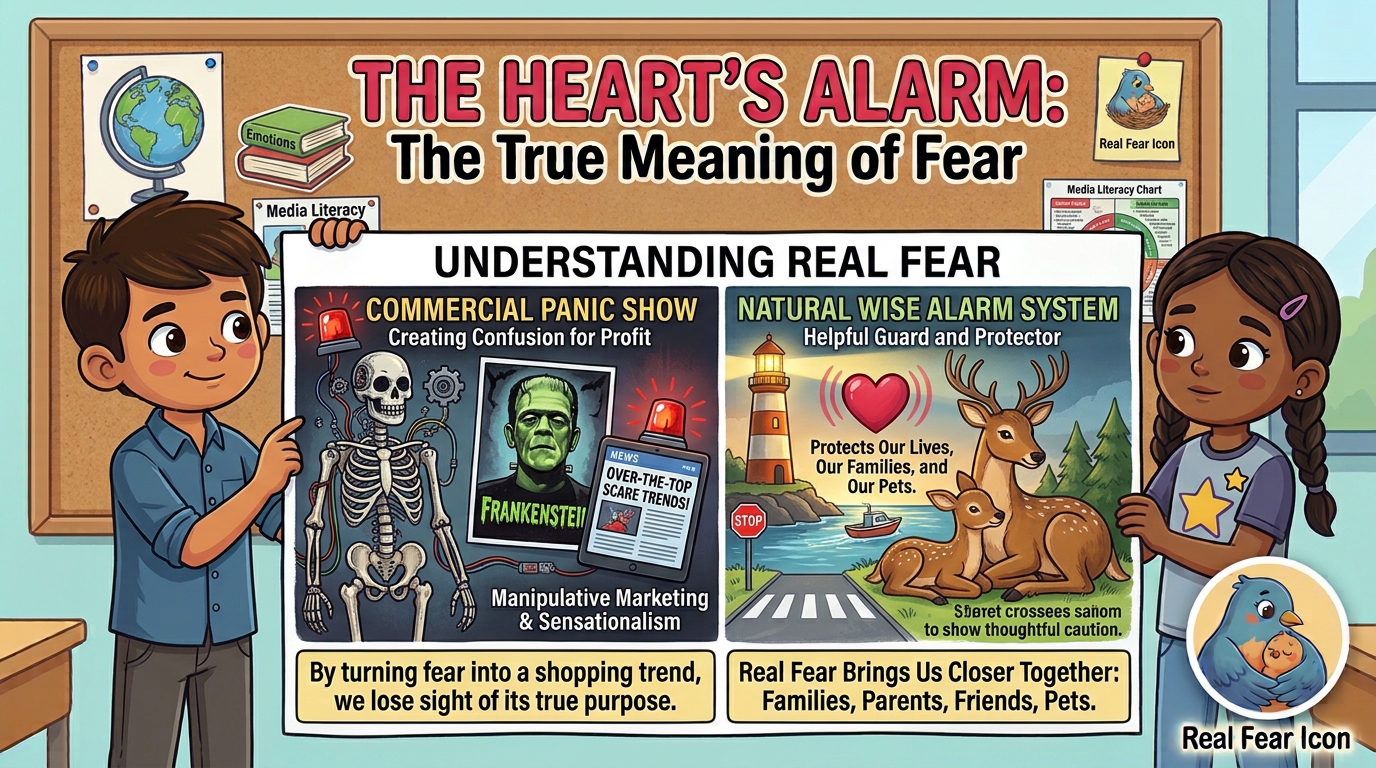
    The teacher suggested a fun activity: looking closely at Halloween adverts and sensational news headlines. Mateo and Nora examined the pictures on a big screen. They noticed how shopping centres use dark colours, loud noises, and fake panic alerts-not to keep people safe, but to make them want to buy terror toys and spooky treats.

    Nora realised that this commercial show twists reality. By turning fear into a shopping trend full of drama, shopkeepers make children afraid of fear itself. People start seeing fear as an evil enemy instead of a natural helper that has a very different job in our lives.

    Their teacher asked a big question: “Is natural fear really a bad thing?” To answer, she showed pictures of nature. Mateo saw that real fear does not need fake costumes or shopping events. Real fear is a wise, natural alarm system, a friendly helper that keeps living things safe from real danger.

    Mateo understood straight away. Natural fear is a clever signal. When we cross a busy street or stand near a high drop, our heart beats faster, our mind focuses, and our senses sharpen. It is not a bad force; it is a helpful guard protecting our precious lives.

    Nora added that natural fear also brings people together. It encourages us to stay close to our families, hug our parents during a thunderstorm, look after our pets, and care gently for the people we love.

    To share what they learned with the whole school, Mateo and Nora made a colourful poster titled “Understanding Real Fear”. They drew a bright lighthouse guiding a safe path, showing the difference between fake Halloween terror and the warm care that keeps us safe.

    That night, while fake giggles and silly monster noises echoed outside, Mateo looked out of his bedroom window feeling completely peaceful. He listened to the steady beat of his heart, knowing that real fear is not a monster made for selling costumes, but a wise signal that protects our lives, our families, and our loved ones.

    📥 Descarga de la Ficha de Trabajo (Worksheet)

    Para acompañar este análisis y reflexionar en profundidad, podéis descargar la ficha completa de actividades:

    🔗 Descargar Ficha de Trabajo – Tercer Ciclo (PDF)

    ¡Espero que disfruten de la historia y les inspire para crear sus propios proyectos! 🛡️✨ No olviden echar un vistazo también al Noticeboard para ver los últimos avisos de la clase.
  • The Heart’s Alarm: The True Meaning of Fear 🐾❤️ (Cuento AICLE / Emocrea – 2.º Ciclo Primaria)

    The Heart’s Alarm: The True Meaning of Fear 🐾❤️ (Cuento AICLE / Emocrea – 2.º Ciclo Primaria)

    ¡Bienvenidos a una nueva entrada en nuestra sección de Year 4A y Resources & Materials! Hoy compartimos el vídeo y la historia adaptada para el Segundo Ciclo de Primaria (3.º y 4.º cursos).

    A través de esta historia, Mateo y su amiga Nora descubren que los anuncios y las tiendas a veces exageran las cosas para vender disfraces de Halloween. Pero lo más importante: aprenden que el miedo real no es un monstruo feo, sino un “salvavidas interior” (smart inner bodyguard) muy inteligente que nos cuida y nos ayuda a proteger a nuestra familia, a nuestros abuelos y a nuestras mascotas. 🐕✨

    📚 ¿Qué áreas trabajamos con este cuento?

    • Emocrea: Conciencia corporal de las emociones, regulación emocional, el valor protector del miedo y fomento de la empatía hacia los seres queridos.
    • Inglés (AICLE / CLIL): Comprensión oral adaptada, vocabulario del día a día y expresiones sencillas en un contexto emocional y cercano.

    📖 The Full Story

    The Heart’s Alarm: The True Meaning of Fear

    By David Toledo

    In late October, Mateo walked through the noisy shopping centre. Everywhere he looked, he saw giant monsters, fake blood, and flashing red lights. Adverts shouted at everyone to buy scary costumes and spooky treats. Mateo felt a tight knot in his stomach.

    At school the next morning, Mateo talked to his friend Nora. Nora said, “Halloween ads and scary movies make fear look like a big, ugly monster. Shops do this so people feel scared and buy lots of stuff!”

    In class, Mateo raised his hand. “Why do adverts make us feel so panicked?” he asked. “They make fear seem like a bad thing that freezes us, but is fear really bad?”

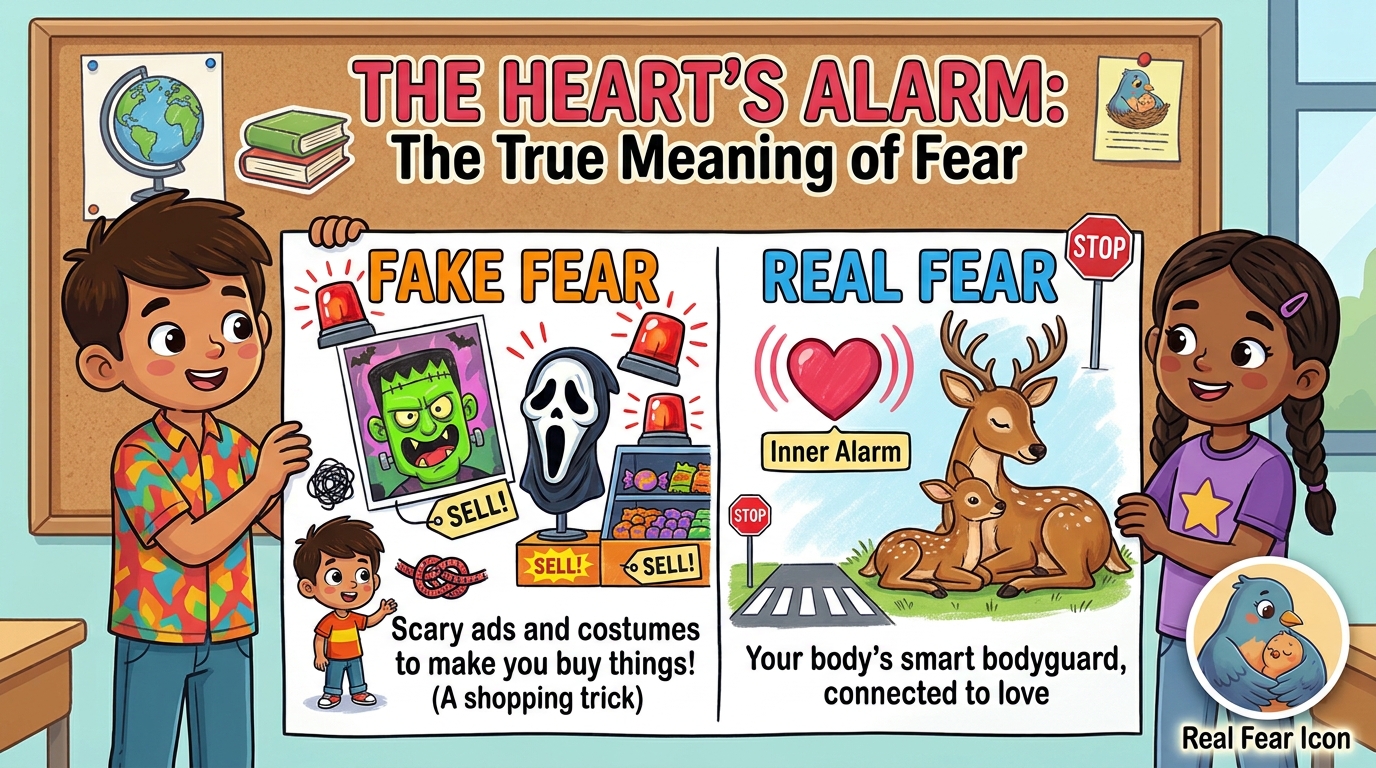
    Their teacher showed them Halloween adverts on a big screen. Mateo and Nora noticed dark colours and fake alarms. They realized shops create fake panic just to sell costumes, sweets, and plastic skeletons.

    Nora smiled as she learned the truth. “Fake fear is just a trick for shopping!” she said. “It makes people afraid of feeling afraid. But real fear is not an enemy at all.”

    The teacher asked, “What is real fear?” She showed pictures of animals in nature. Mateo saw a mother deer guarding her baby. “Real fear is like a smart inner bodyguard,” Mateo said. “It helps living things stay safe.”

    Real fear is our body’s protective alarm system. When Mateo stops at a busy street, his heart beats faster and he looks both ways carefully. The alarm keeps him safe from real danger.

    Nora realized that real fear is deeply connected to love. It encourages us to stay close to our parents, care for our grandparents, and hug our loyal dog during a loud thunderstorm.

    Together, Mateo and Nora made a bright poster called “Real Fear vs Fake Fear”. “Feeling fear is natural,” Mateo explained. “It shows how much we love our family, our pets, and our lives!”

    That night, while fake monster giggles echoed outside, Mateo looked out his bedroom window. He felt peaceful and safe. He knew that real fear was not a monster made for selling costumes, but a wise signal that protects the people we love most.

    📥 Descarga de la Ficha de Trabajo (Worksheet)

    Para repasar todas las actividades en clase o en casa, podéis descargar la ficha de trabajo correspondiente a este ciclo:

    🔗 Descargar Ficha de Trabajo – Segundo Ciclo (PDF)

    ¡Dale al play al vídeo y aprende cómo funciona el gran protector de nuestro cuerpo! 🛡️💙 No olvides revisar las últimas novedades en el Noticeboard.

  • Fake Fear and Real Fear 🎃🛡️ (Cuento en inglés para 1.º y 2.º de Primaria – Emocrea/AICLE)

    Fake Fear and Real Fear 🎃🛡️ (Cuento en inglés para 1.º y 2.º de Primaria – Emocrea/AICLE)

    ¡Bienvenidos a una nueva entrada en nuestro blog! Hoy compartimos el vídeo “Fake Fear and Real Fear” (El miedo falso y el miedo real), un cuento corto en inglés adaptado para el alumnado de Primer Ciclo de Primaria (1.º y 2.º cursos).

    A través de una sencilla historia, acompañaremos a Mateo y Nora a descubrir la diferencia entre los “monstruos falsos” de los anuncios de las tiendas y el “miedo real”. Los más pequeños aprenderán que el miedo natural no es malo, sino una señal inteligente (smart signal) de nuestro cuerpo para mantenernos a salvo y proteger a nuestra familia y mascotas. 🐕💕

    📚 ¿Qué áreas trabajamos con este cuento?

    • Emocrea: Identificación de emociones básicas, comprensión de las señales del cuerpo y fomento de la empatía.
    • Inglés (AICLE / CLIL): Vocabulario adaptado, 100% accesible, con oraciones cortas y de fácil comprensión auditiva.

    📖 The Story

    Fake Fear and Real Fear

    By David Toledo

    In October, Mateo went to the store. He saw big monster posters and bright lights. The ads wanted people to buy scary costumes. Mateo felt a little bit worried.

    The next day, Mateo spoke to his friend Nora. Nora said, “Stores make fake monsters! They do this so people buy extra toys and sweets.”

    In class, Mateo raised his hand. “Is fear bad?” he asked. Nora listened carefully.

    Their teacher showed them Halloween ads. Mateo and Nora looked at fake ghosts and funny masks. “This fake fear is just to sell stuff,” Nora said.

    Nora smiled. “Fake monsters are not real danger. It is just a trick to make people buy things!”

    Mateo looked at a picture of a mama bird protecting her baby. “Real fear is different,” Mateo said. “It is like a smart signal inside us!”

    Real fear is our body’s alarm system. When Mateo stops at a busy street, his heart beats fast. The alarm says, “Stop! Look both ways!”

    Nora learned that real fear protects the ones we love. During a loud storm, she holds her puppy close to keep him safe.

    Mateo and Nora made a big poster together. “Fake fear sells costumes,” Mateo said. “Real fear helps us protect our family and pets!”

    That night, Mateo looked out his bedroom window. He heard silly monster sounds outside, but he felt safe. He knew real fear was his body’s way of keeping him safe.

    📥 Descarga de la Ficha de Trabajo (Worksheet)

    Para que los más pequeños puedan repasar y realizar las actividades asociadas a este cuento, podéis descargar la ficha de trabajo en PDF:

    🔗 Descargar Ficha de Trabajo – Primer Ciclo (PDF)

    ¡Dale al play y descubre cómo tu cuerpo te cuida! 🛡️✨ Recuerda que puedes consultar las tareas diarias y más recursos en las secciones de Noticeboard y Resources & Materials de nuestro blog.